
The Task Is Dying. Long Live the Goal.
Notes on the future of work from a junior developer who is watching it happen in real time

A few weeks ago, I gave an AI agent a job. Not a prompt — a job. I told it: "Read this repository, find the three weakest parts of the documentation, rewrite them, and open a pull request." Then I made tea.
By the time the tea was ready, the pull request was open. The commits were clean. The commit messages were better than the ones I write at 1 AM.
I sat there for a moment, and a thought landed that hasn't left me since: everything I was trained to do in my first job, a machine just did as a warm-up exercise.
I am a junior developer. I come from Nepal, I'm studying information technology, I spend my nights building open-source projects about AI agents, and I am — by every honest measure — at the very beginning of my career. So when people ask me, "Aren't you scared that agents will take your job before you even get it?" I understand the question. I've asked it to myself.
But after months of reading the people who are actually building this future — and after building small pieces of it myself — I've come to a different conclusion. The future of work is not a story about replacement. It's a story about rearrangement. And the people who understand the new arrangement early will have an almost unfair advantage.
This article is my attempt to map that rearrangement. Everything here is my own synthesis — my own words, my own frames, my own bets. I was provoked into writing it by three very different visions I recently sat with: Mark Zuckerberg's argument that superintelligence should be personal and belong to everyone, Dario Amodei's warning that our technology is entering a turbulent adolescence, and Fei-Fei Li's lifelong insistence that AI must remain human-centered. I agree and disagree with parts of each. What follows is where I've landed.
Part 1: Three visions, one question
Strip away the branding and the caution labels, and all three visions are circling the same question: when machines can do almost everything, what is a human for?

Three open volumes: converging intellectual perspectives.
One camp answers: the human becomes the director. Give every person a brilliant, tireless personal agent that knows their goals, works around the clock, and turns a single individual into something like a small company. Power to the person. Let a billion ambitions bloom.
Another camp answers: be careful. We are handing ourselves a force we don't fully understand, and our institutions — schools, companies, governments, laws — are teenagers being handed the keys to a very fast car. The economy could be disrupted faster than people can adapt. The gap between what machines can do and what society can absorb is the real danger zone.
The third camp, the one I feel closest to, answers with a quieter reminder: intelligence was never the point. Dignity is the point. Curiosity is the point. The reason a young girl from Chengdu can end up building ImageNet and changing the history of AI is not because she was the most efficient worker in the room. It's because she saw a question nobody else was asking. Machines can see the world now. But deciding which worlds are worth seeing — that remains ours.
My own view sits at the intersection of all three, and it can be stated in one sentence:
“The future of work belongs to people who stop selling their tasks and start selling their direction.”
Let me explain what I mean, because this distinction — between tasks and direction — is the entire game.
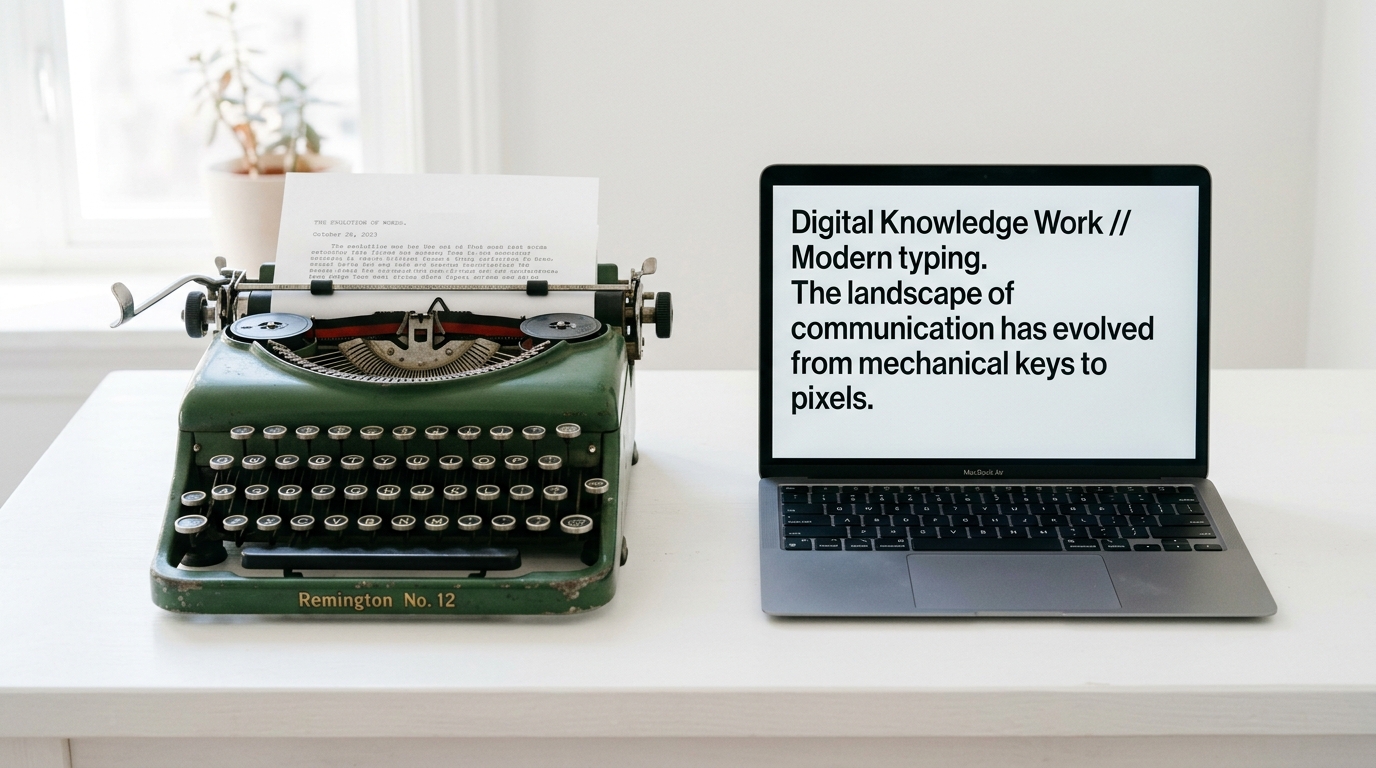
From mechanical typing to cognitive keystrokes: the dissolution of routine tasks.
Part 2: The task is the new keystroke
For most of history, work was sold by the task. Type these letters. File these papers. Write this function. Test this feature. Answer this ticket. Your job title was basically a bundle of tasks with a salary attached.
Here is my core claim: the task is becoming the new keystroke.
Think about what happened to typing. There was a time when "typist" was a profession. Then keyboards became universal, and typing didn't disappear — it dissolved. It became something everyone does, invisibly, inside every other job. Nobody hires you to type. Typing is assumed.
That is exactly what is about to happen to a huge portion of knowledge work. Summarizing a document, drafting an email, writing boilerplate code, doing a first-pass analysis, researching a competitor, filling a spreadsheet — these will not be jobs. They will be keystrokes. Assumed. Invisible. Done by agents humming in the background of every role.
I can already see this in my own tiny workflow. When I build features for my open-source project, I don't "write code" the way I did two years ago. I describe behavior. I review diffs. I reject approaches. I reshape architecture. The typing — the task — has already started dissolving for me, and I'm a nobody with a laptop and a free-tier account. Imagine what this looks like inside a company with real compute.
So if tasks dissolve, what's left? What's the actual unit of work in the agent era?
The goal.
The future of work is a market in goals. Humans who can look at a messy, ambiguous situation and say "that — that is the thing worth doing" — and then decompose it, delegate it, judge the results, and take responsibility for the outcome. Agents will do the tasks. Humans will own the goals.
This is the rearrangement. Not human versus machine. Goal-setter versus task-doer — and the task-doer is increasingly made of silicon.
“The task is becoming the new keystroke.”

The 2031 workspace: orchestrating agent fleets, judgment blocks, and human commitment.
Part 3: A working day in 2031
Let me make this concrete. Here's how I honestly expect a workday to look for someone like me in about five years. Call it a Tuesday in 2031.
I wake up and my agent team has already been working for hours. Not one agent — a small crew. My research agent has scanned overnight developments in the two domains I work in and flagged three things that actually matter to my current projects, ignoring the other nine hundred headlines. My code agent finished a refactor I scoped before sleeping and left a structured summary of the decisions it made and the two places where it wasn't confident. My inbox agent has drafted replies to everything routine and escalated exactly four messages that need a human — me.
This is the part of the day that is actually mine, and it's the part that matters most. I review the refactor. The code works, but I can see the agent optimized for elegance where the project needs readability for new contributors — something it couldn't know because it's written nowhere in the codebase. That's taste. That's context. That's the job now. I redirect it in two sentences.

Human judgment over raw automation: taste, context, and intent.
A client (or my employer, or my own users — the lines blur) wants a new capability built. I don't estimate in hours anymore; I estimate in agent-days and review-loops. I break the goal into six delegable chunks and two non-delegable ones. The non-delegable ones are the parts where being wrong is expensive: the data model, the security boundary. Agents are astonishing, but accountability still has a human signature on it. I keep those.
My operations agent negotiates directly with a vendor's sales agent over an API contract. They settle price and terms in forty seconds. Both sides flag the agreement to their humans for a one-tap approval. This sounds strange until you realize your email spam filter has been negotiating with other people's mail servers on your behalf for twenty years. We just never called it work.
A call with a collaborator. No agents in the room — or rather, agents everywhere in the room, but the point of the call is trust, and trust is still built face to face, voice to voice, joke to joke. We argue about direction. We change our minds. No agent can do this part, because this part isn't about answers. It's about commitment.
My tutor agent — patient, personalized, knowing exactly where my understanding of distributed systems breaks down — runs me through forty minutes of precisely calibrated teaching. The kind of tutoring that used to be reserved for the children of the wealthy is now a utility. This, more than anything else, is what makes me optimistic.
Notice what disappeared from this day: the tasks. Notice what grew: direction, judgment, taste, trust, and learning. The day isn't empty. It's promoted.
“The day isn't empty. It's promoted.”
Part 4: The five skills that survive
People keep asking "which jobs will survive?" I think that's the wrong question. Jobs are bundles, and the bundles are being torn apart and rebuilt. The right question is: which human skills appreciate in value when tasks become free?
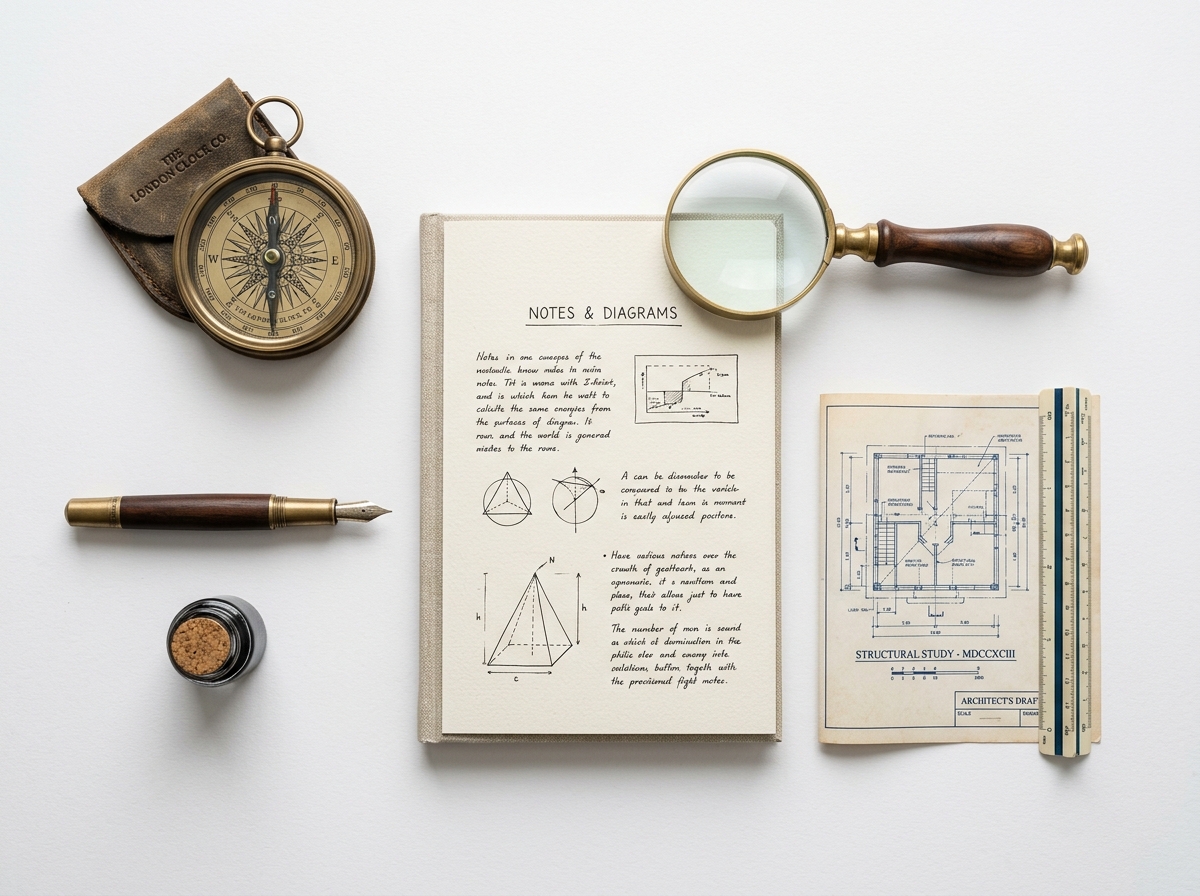
Compass, fountain pen, notes, magnifying glass, blueprint.
Here's my list, earned from watching my own workflow transform:
1. Problem selection
When execution is cheap, the scarce resource is knowing what's worth executing. An agent can build anything; it cannot tell you whether the thing deserves to exist. Choosing the right problem is the highest-leverage skill of the agent era, and it comes from lived experience, domain obsession, and empathy — not from compute.
2. Taste
Agents generate. Humans curate. The difference between a good product and a great one, a good essay and a true one, is a thousand micro-judgments that can't be fully specified in a prompt. Taste is compressed experience, and it compounds. Protect yours.
3. Accountability
Someone has to sign. Someone has to be responsible when the agent's work fails in the real world — the bridge, the diagnosis, the contract. "The agent did it" will never be an acceptable answer in a courtroom, a hospital, or a family. The humans who can stand behind outcomes will be paid like it.
4. Trust-building
When everyone has infinite generation capacity, authenticity becomes the differentiator. Why would a client choose you over the ten thousand other people with identical agent fleets? Because they trust you. Reputation, relationships, and a public track record — things that can't be synthesized overnight — become the real moat.
5. Translation between worlds
The most valuable people I see are the ones who can stand at a boundary: between a technical system and a business need, between a global tool and a local context, between what the agent produced and what the human actually meant. Agents are brilliant inside a frame. Humans are the ones who notice the frame.
Notice what these five have in common: none of them are tasks. All of them are forms of direction.

Collapsing the leverage gap: building frontier software from Kathmandu to the world.
Part 5: The great leveling — a view from Nepal
Now let me tell you why this matters to me personally, and why I think the loudest debates about the future of work are missing the biggest story.
I grew up in Nepal. I'm writing this as someone who knows exactly what it means to be on the wrong side of the leverage gap. For decades, the deal was brutal: talent was evenly distributed across the world, but opportunity was not. A brilliant developer in Kathmandu or Biratnagar had a fraction of the leverage of an average one in San Francisco — because leverage came from institutions, and institutions lived elsewhere.
Agents change that equation at the root.

A single laptop and an agent fleet: direct global leverage.
When the cost of execution collapses — when one person with a laptop and an agent fleet can research, build, design, market, and operate at a level that used to require a funded team — then the old gatekeepers lose their gate. The question stops being "which company hired you?" and becomes "what can you direct?"
This is the part of the "superintelligence for everyone" vision that I genuinely believe, because I'm already living the preview. From a room that my family's generation would have considered the middle of nowhere, economically speaking, I can ship open-source software that people I've never met depend on. I can learn from the best teachers on Earth for the price of an internet connection. I can compete — not on equal footing yet, but on possible footing, which is a revolution all by itself.
I predict the next decade produces the first wave of one-person and few-person companies from places the tech map currently ignores. Small teams with agent fleets, running businesses at a scale that used to require hundreds of employees. The economy doesn't shrink when this happens — it fractals. More companies, smaller each, more ideas tried, more niches served. A kid in a garage was the symbol of the last era. A kid with a goal and a fleet of agents is the symbol of the next one.
But — and this is a serious but — the leveling only happens if access stays wide and cheap. If the best intelligence is locked behind prices that only rich countries and rich companies can pay, then agents don't level the playing field; they tilt it further. The single most important policy question of the agent era is not "how smart will the models get?" It's "who gets to point them at their dreams?" Free tiers, open models, affordable compute — these aren't charity. They're the difference between a future for everyone and a future for the few hundred million who got there first.
Part 6: The dangers I actually worry about

Autopilot mode: flying more without forgetting how to fly.
I promised honesty, so here it is. I am an optimist, but I'm not a sleepwalker. There are four risks in the agent era of work that I think about constantly — and none of them are the robot-apocalypse kind.
Deskilling
If agents do the tasks, and tasks were how juniors became seniors, where do the next seniors come from? I feel this one personally — I'm a junior right now. If I let agents do all my thinking, I become a reviewer of work I could never produce, and my judgment quietly rots. The discipline of the agent era is to use agents the way a pilot uses autopilot: to fly more, not to forget how. I still write code by hand. I still debug without assistance sometimes. Not because it's efficient — because it's training.
Dependency and fragility
A workforce that runs on agent fleets is a workforce with a new single point of failure. Outages, price changes, model updates that break your workflows, providers who can switch off your leverage overnight. Owning your skills, your data, and your workflows — and preferring open systems where possible — is not ideology. It's insurance.
The meaning gap
Work was never only income. It's identity, structure, pride, community. If agents absorb the doing faster than we rebuild the meaning, we get a generation that is richer and emptier at the same time. I don't have a neat answer for this. I suspect the answer is that humans will pour the freed time into the things that were always the point — craft, care, exploration, each other — but transitions are where people get hurt, and this transition will be fast.
Speed itself
This is the part of the "technological adolescence" warning that lands for me. The risk isn't that the technology is evil. It's that it's fast — faster than schools can redesign curricula, faster than labor markets can reprice skills, faster than a country like mine can update its policies. Teenagers aren't bad; they're just not ready for the power they're given. Our institutions are about to be handed enormous power, and their maturity is the bottleneck. The builders who take that seriously — who build in the open, disclose failures, and treat safety as engineering rather than PR — deserve more support than the ones racing with their eyes closed.
Part 7: What I'm doing about it (and what I'd tell anyone starting out)

Public code and open notebooks: betting on relevance.
I'm not a CEO or a famous researcher. I'm a student with a GitHub account and unreasonable levels of curiosity. So let me end with the practical part — my own operating manual for the agent era, in case it helps someone standing where I'm standing.
Build with agents, publicly
Don't just use them — understand them. I started building an open-source project around agent skills precisely because the best way to not be replaced by a system is to understand it deeply enough to direct it, extend it, and fix it. Every commit is a small bet on my own relevance.
Collect goals, not tasks
I keep a notebook of problems worth solving — things I notice in my own community, frictions in tools I use, gaps in open-source projects. Tasks get automated. A rich, personal inventory of meaningful problems never does.
Train taste deliberately
I read excellent code and terrible code and force myself to articulate the difference. I rewrite agent output until it sounds like something I'd sign. Taste is a muscle; reps matter.
Learn like it's a utility, because it is
The personalized-tutor future is already here in early form. The gap between "people who use AI to avoid learning" and "people who use AI to learn faster than anyone in history" is going to define the next decade of careers. Be the second kind.
Stay human on purpose
Write some things yourself. Meet people. Do unscalable favors. In a world of infinite generated content, a genuine human signal — a real voice, a real story, a real relationship — doesn't lose value. It becomes the scarcest asset there is.
“Goals are the most human thing there is.”

Direction over destination: building what remains.
Closing: the future is a direction, not a destination
Here's what I finally concluded after sitting with the optimists, the worriers, and the humanists.
The optimists are right that this technology can put more power in an individual's hands than any invention since the internet — maybe since electricity. The worriers are right that we're adolescents being handed that power, and that speed plus immaturity is how accidents happen. And the humanists are right about the deepest thing: the measure of this era won't be how intelligent our machines became. It will be whether ordinary people — including people from the overlooked corners of the map, including students with laptops and big ambitions — ended up with more agency, more dignity, and more worlds worth seeing.
The task is dying. Let it. Tasks were never the point of a human life.
The goal is what remains. And goals — choosing them, committing to them, standing behind them — are the most human thing there is.
The future of work isn't something that's going to happen to us. It's something that gets built, one directed agent, one chosen problem, one public commit at a time.
I'm building my piece of it from here. I hope you build yours.
Rahul Chaube
Founder & CEO, EverestQ · Language Architect, Blyx
Building AI infrastructure for South Asian languages from Kathmandu, Nepal.